
The Human IS the technology.
When the Greats Disagree with Technological Progress

“We must reflect more deeply than we do on the effect of modern technological life upon the emotional instinctual development of man. It is quite possible that the person whose life is divided between tending a machine and watching TV is sooner or later going to suffer a radical deprivation in his nature and humanity.”
- Thomas Merton, Life & Holiness.
There has been more technological progress in the last 400 years than the past 40,000 of recorded history. Naturally, our cultural assumption is that all new developments should be radically better than the next, as our history has proven.
As the 2026 Super Bowl ad for Starlink suggests, we have a salvific view of technology, that it will be glorious and that it will save us — Oh what hath Starlink wrought.
Yet, if you scan any list of the top literature of Western Civilization, one finds:
If we’re being generous in our selection, 70-80% or more were written before the printing press (1500s)
And if we’re even more generous, maybe 90% were written before the personal computer (but even assuming 10% since the 1980s may be too generous)
That means a shocking amount of works that define western civilization were written well before modern technology.
So as our technology develops…shouldn’t these newer and better tools help us make more and better things? From art to literature to…everything? Technological progress is ironclad, right?
Progress suggests that with each new iteration, that we should be able to do things faster, easier, and MORE. And yet…
If these tools are so wonderful, why are there not more and better works of art because of newer tech, like computers or AI?
Or put another way, if tech progress is supreme and our tools are so good, where are the laptop Shakespeares, iPad Dantes, or AI Aquinas?
Why have the majority of our greatest works come before both the printing press and the personal computer?
Many have noted how poor we are culturally, that older music and movies are doing better than current works.
As companies build AI into their products, the assumption continues that we should be capable of even greater things, all because these technological wonders keep marching onward. Shouldn’t newer and better tools help us to make more and better work? Thus sayeth the dogma of progress.
But like those dumb software upgrades, some of today’s brightest authors seem to have opted out of the latest tech updates too (sorry AI!). Just look at the number of living authors who still use low-tech to no-tech— it’s astounding:
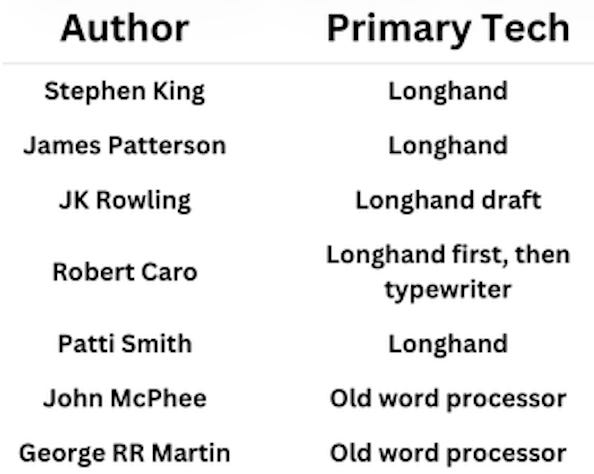
Even comedians use the power of the the legal pad & pen over the laptop, as Jerry Seinfeld said (I’m time stamping right where he mentions it, but it’s a brief part, so no need to watch the entire thing):
I always thought examples like these were relics of a fading era, like “oh, look at them, they succeeded in spite of their handicap...”
And then I ran across this quote, and was dumbfounded:
“Thomas Aquinas…had perhaps only twenty-five years of productive activity in the thirteenth century. He had none of the mechanism” (of today, such as computers)…”yet, Aquinas produced an amount of brilliant and profound matter that is simply astounding. How did Aquinas do it? It is highly doubtful that he would have written more or better if he had the latest computer at his disposal. In fact, in some sense it may have been a hindrance.” James Schall, in the forward to the Intellectual Life by A.G. Sertillanges. (Bold my emphasis)
Why is low to no-tech the tool of choice for today’s top authors? All but Martin and McPhee (from what I can gather) do some portion of their drafts longhand—just as our our ancestors did thousands of years ago before them.
Maybe one of the listed authors has written something on the level of Shakespeare or Dante…but most did it with tools similar to 400 years hence (hence sounds waaaay more Shakespearian than before, no?)…why?
If success leaves clues, it would be shortsighted to dismiss their tools to just old codgers, dinosaurs of a bygone era. They’ve sold millions of copies, won countless of awards, surely they’ve put some thought into their craft? And they have…
“I have only said that a computer cannot help you to write better, and I stand by that. (In fact, I know a publisher who says that under the influence of computers — or of the immaculate copy that computers produce— many writers are now writing worse).” - Wendell Berry, Why I am Not Going to Buy a Computer (Bold my emphasis)
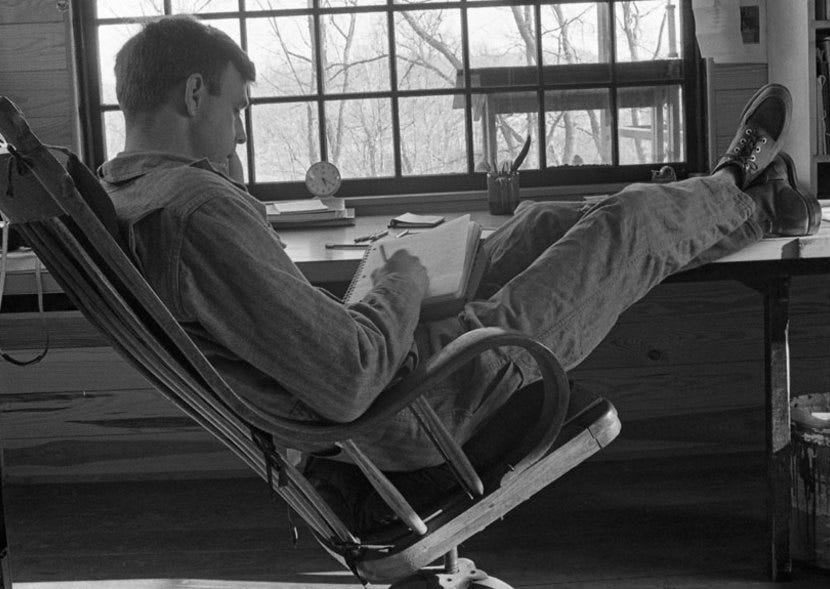
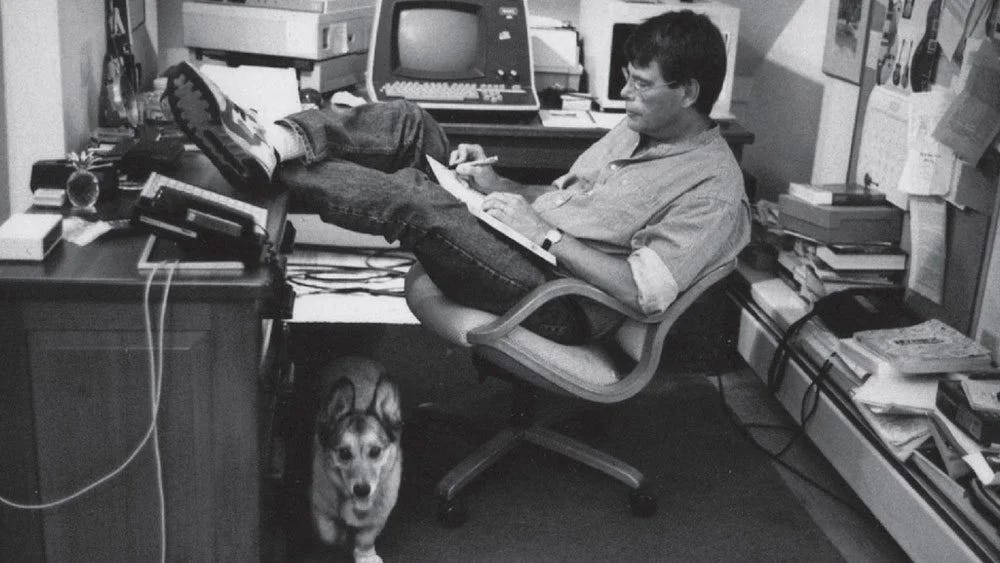
On using a pen, Stephen King said it’s “the world’s finest word processor…It slows you down. It makes you think about each word as you write it.”
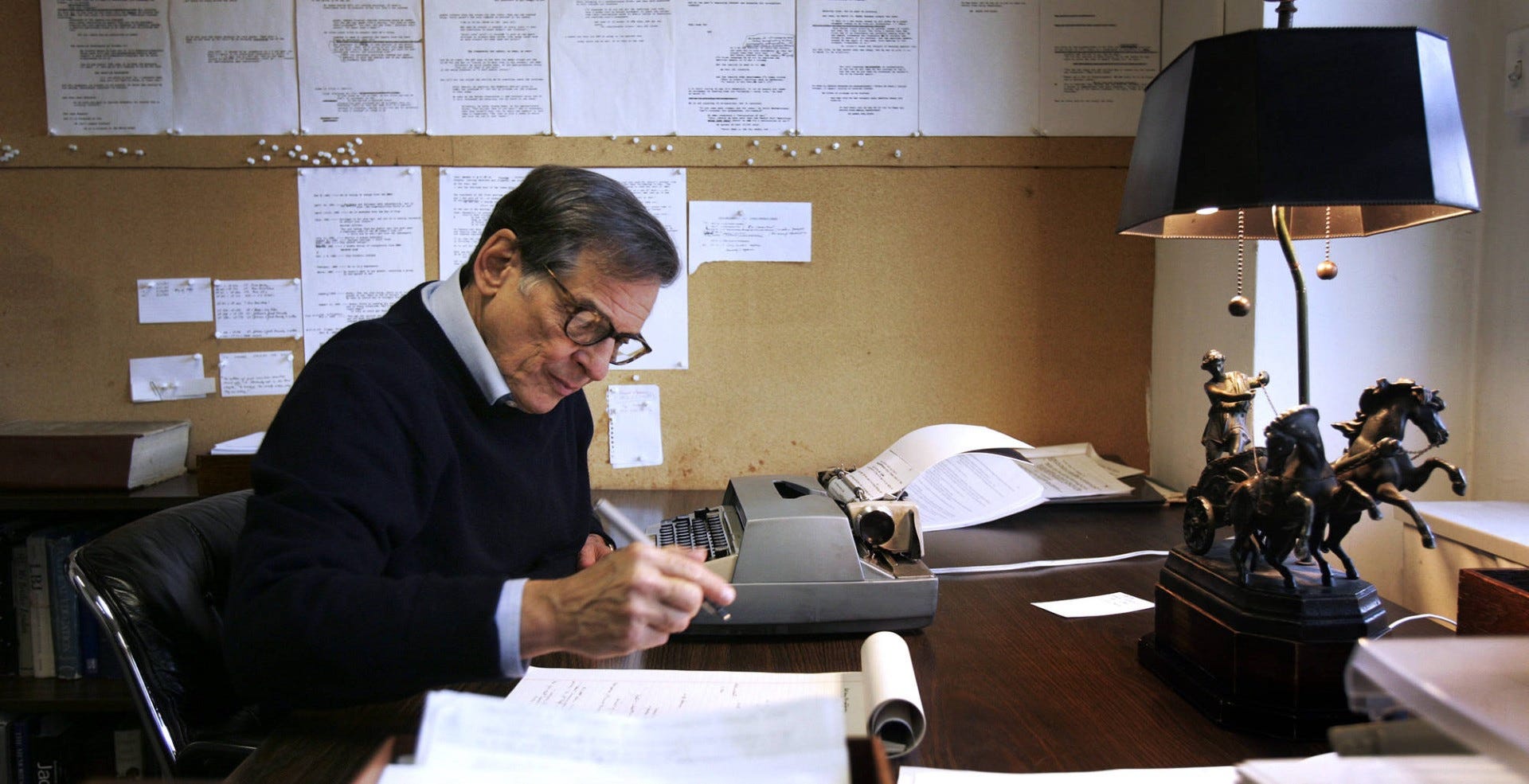
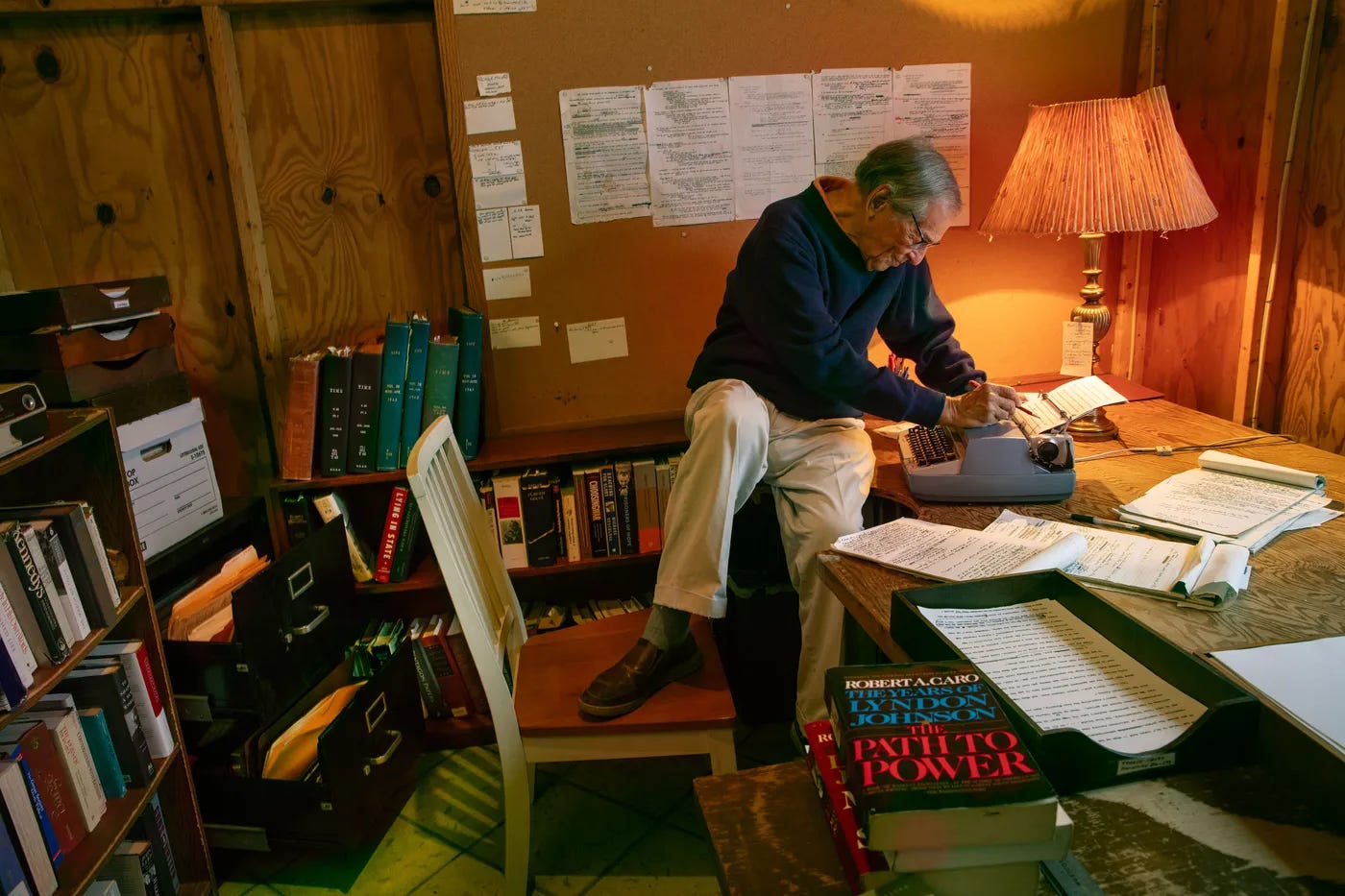
“As I’ve said, I write my first drafts in longhand—pen or pencil—on white legal pads, narrow lined. I seldom have only one draft in longhand—I’d say I probably have three or four. Then I do the same pages over on a typewriter.” - Robert Caro, Working.
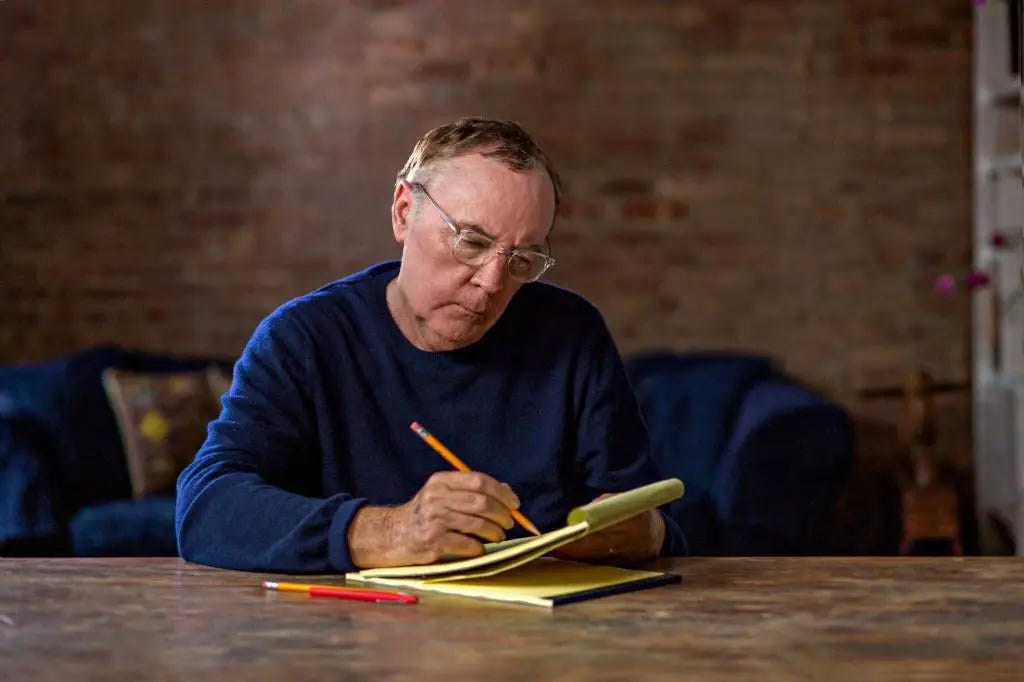
“I did the first draft in pencil. But then I typed. The two-finger minuet. I had to reach up to the counter to peck at the keys of my faithful Underwood Champion. Eventually, I hurt my back. That’s when I stopped typing and started writing everything in pencil again. I still write in pencil. I’m writing this with a number 2 pencil.” - James Patterson
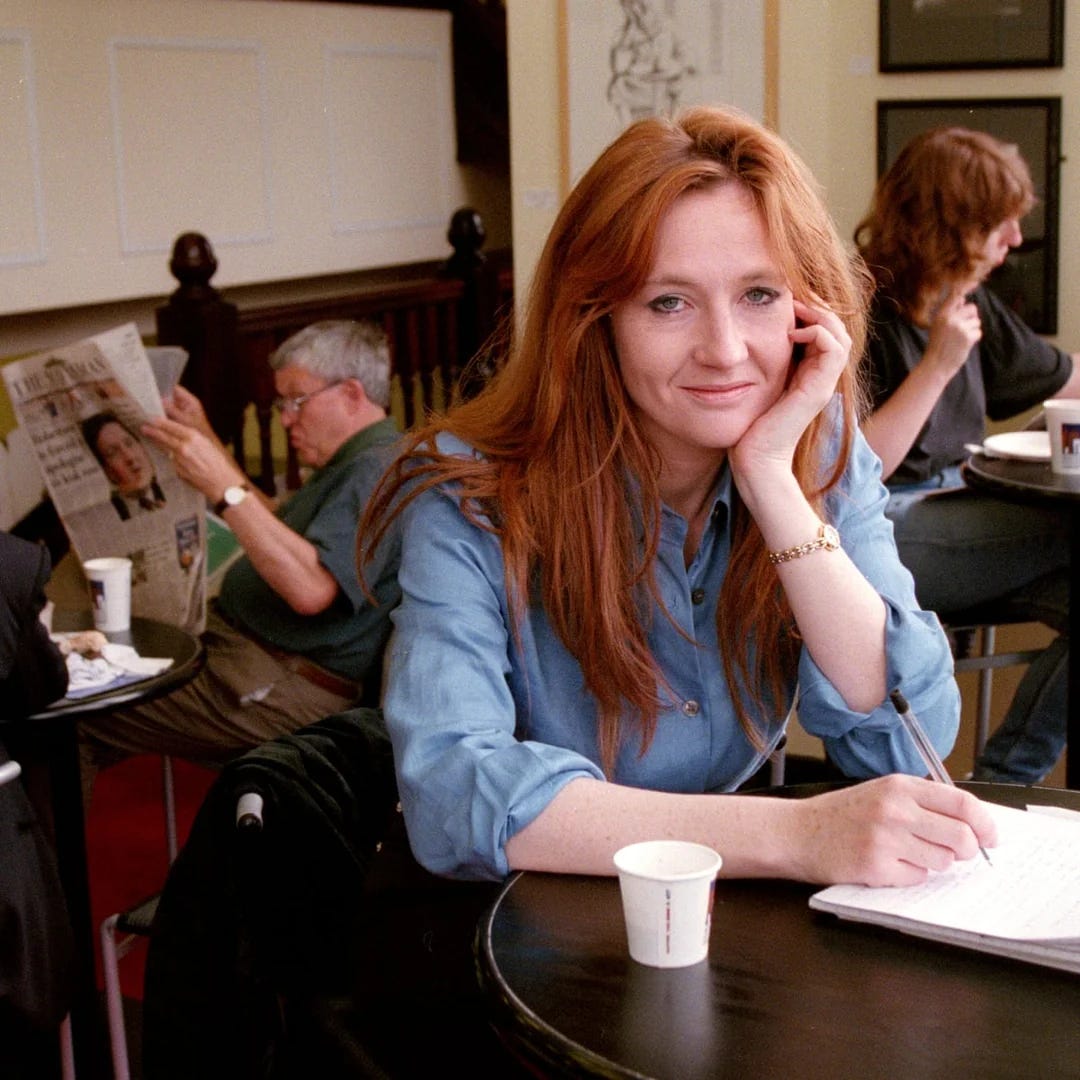
“I still like writing by hand. Normally I do a first draft using pen and paper, and then do my first edit when I type it onto my computer. For some reason, I much prefer writing with a black pen than a blue one, and in a perfect world I’d always use “narrow feint” writing paper. But I have been known to write on all sorts of weird things when I didn’t have a notepad with me. The names of the Hogwarts Houses were created on the back of an aeroplane sick bag. Yes, it was empty.” - JK Rowling
And listen to George RR Martin’s rather luddite attitude for computers:
If the story of technological progress is true, that the newer is better, why do so many successful writers avoid the latest tech?
Cognitive Offloading…Kinda
The nature of technology is leverage — to do more with less. As our tech fuses into everyday decisions, we are offloading more of the mental work: Our GPS picks the best route. Our virtual calendars remember for us.
The speed and ease of use is what makes modern life “modern.” Nobody wants to haul their dirty laundry down to the creek and scrub their clothes on a washboard. *cue the banjo*
Though some tasks can be done faster, few aspects can be fully offloaded. Writing is a clear example.
The core of writing is thinking. You can’t write much without first thinking, and you can’t write well without thinking clearly. As the saying goes, it’s garbage in, garbage out.
No matter what app you use, you cannot eliminate the inherent friction within the writing process because your thoughts are the writing process. This is true for other fields beyond writing itself, that the quality of your thought is the quality of your work. Quality knows no bounds.
Even if they claim you can, and they definitely are claiming you can, you cannot offload thinking to AI.
Efficiency vs Effectiveness
Your quality of thought precedes the quality of your writing — there’s no hack for shortening your thinking time.
A fundamental point at the core of the tech ideology is that it assumes that because it can be done faster, it can therefore be done better — all work is reduced to the lowest common denominator of tasks.
It’s conflating efficiency with effectiveness. Any task could be more efficient (in theory), but for things of quality, lasting works of art are not judged by how quickly they were made, but by their impact: their thoughtful details, their usefulness, their quality, and their beauty.
The quality of your work can only happen at the speed of your ability to think — and many of these writers keep saying that speed itself isn’t helpful for depth.
Look at what Robert Caro said about a college professor after putting in minimal effort for his writing assignments:
“I thought I was fooling him about the amount of preparation and effort I had put into it. At that final meeting, however after first saying something generous about my writing, he added: ‘But you’re never going to achieve what you want to, Mr. Caro, if you don’t stop thinking with your fingers.” Robert Caro, Working. (Bold my emphasis)
New technologies give a false impression, that just because words are on a page they are even worth reading. Yet, while there are dozens of apps to put words down faster, there is no “hack” to eliminate thinking from the process.
It seems that when quality matters, the speed of modern tech can be a disadvantage and even compromise depth.
Real World Results
Go with me on a quick detour…
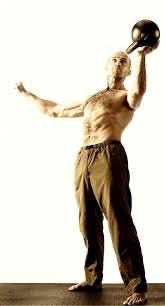
Let me introduce you to Pavel Tsatouline, the “father” of the kettlebell movement in America specifically, but more important, the guy who first advocated for “functional strength.”

Hang with me…
Pavel advocates for more free weight usage, like kettlebells, because you use whole muscle groups at once, just as in real life.
In contrast, weight machines isolate a specific muscle during a work out. Yet in the wild we seldom use a single muscle, all by itself.

This is why there are so many stories of bodybuilders and gym bros that have no functional strength in real world situations.
Weight machines focus exercise so narrowly, they limit its effectiveness.
Now, look at this…
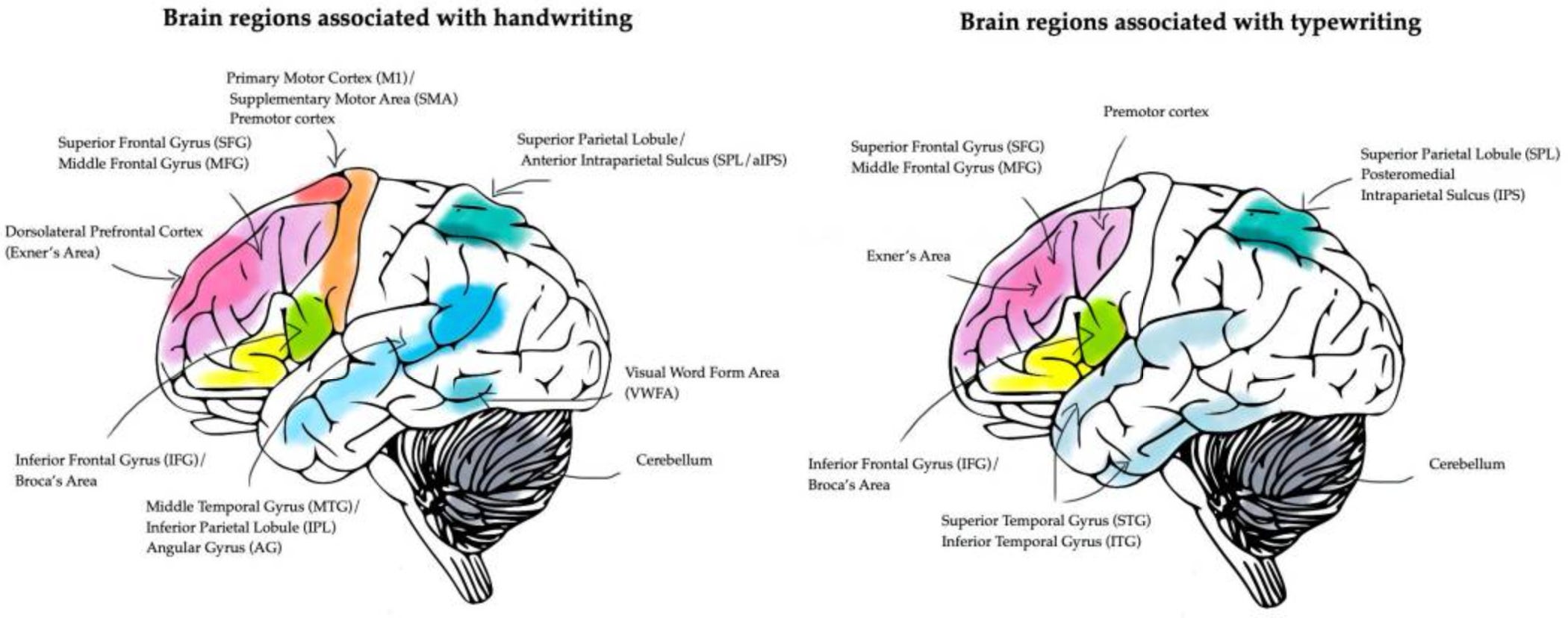
This is a chart from an NIH study depicting the cognitive benefits of writing by hand vs typing, and showing which areas of the brain lit up with each activity:
“Handwriting activates a broader network of brain regions involved in motor, sensory, and cognitive processing, contributing to deeper learning, enhanced memory retention, and more effective engagement with written material. Typing, while more efficient and automated, engages fewer neural circuits, resulting in more passive cognitive engagement. These findings suggest that despite the advantages of typing in terms of speed and convenience, handwriting remains an important tool for learning and memory retention, particularly in educational contexts.” (Bold my emphasis)
For our brains, a computer is like a weight machine: it isolates parts of our brain, but doesn’t engage our full cognitive abilities. A pen and paper do, and give more real world benefits (you should just google how many therapies—physical as well as emotional—that use writing by hand for growth and recovery…there’s a reason).
A computer is to a weight machine as a pen is to a kettlebell.
The wrong tool leads to less functionality and poorer outcomes.
Therefore…

(If you don’t know this SNL Sketch and have 5:42 seconds to waste…you’re welcome.)
Right Tools for the Journey
We’re not trying to romanticize specific tools (so cancel that order for more ink and quill pens!)
The point is to understand how our tools affect us and therefore affect the quality of our work. Look at what Wendell Berry said about how a pen shapes his writing:
“The computer apologist it seems to me, have greatly underrated the value of the handwritten manuscript as an artifact. I don’t meant that a writer should be a fine calligrapher and write for exhibition, but rather that the handwriting has a valuable influence on the work so written…as longhand is transformed into typescript, it seems increasingly resistant to improvement. More and more spunk is required to mar the clean, final-looking lines of type. I have the notion — again not provable — that the longer I keep a piece of work in longhand, the better it will be.” - Wendell Berry, Why I am Not Going to Buy a Computer (bold emphasis mine).
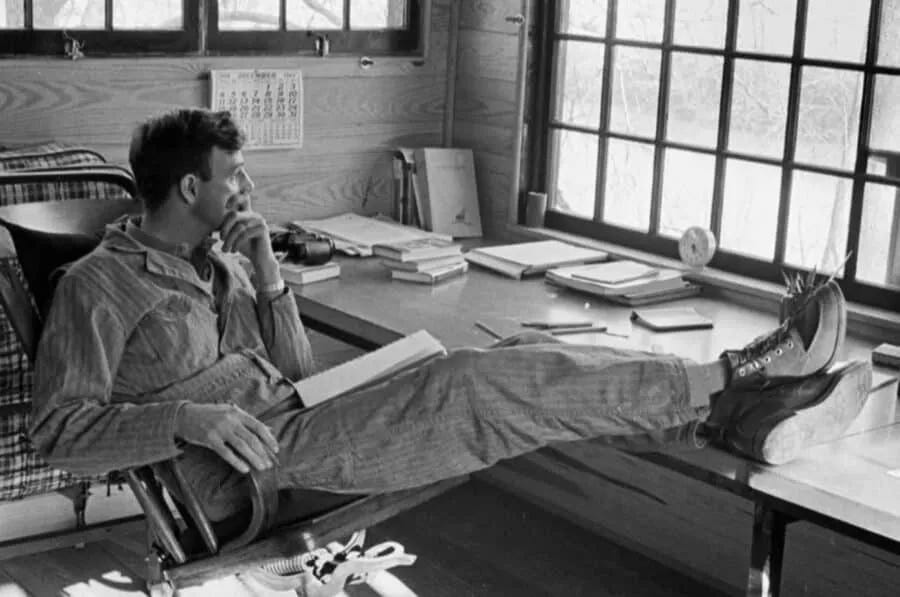
And it’s not just writing by hand. Other low-tech tools and processes may contribute to depth too.
Look at what Ryan Holiday said about Robert Caro’s writing process with a typewriter and why, even as friction filled as it is, it might have some secret advantages (listen for about one minute for his full comment):
He said it briefly, but what he suggests is profound:
Inefficiency could be an advantage for your work *mind blown*
The process of writing (longhand) and then transferring to a typewriter (retyping each following draft) IS an advantage
A sentence on Google Docs or Microsoft Word is “weirdly more permanent” because you’ll never retype the same sentence. If you write longhand or on a typewriter, you must retype each sentence and paragraph…Every. Single. Time.
“If you had to retype your book, multiple times, you would have a different sense of the rhythm of it.”
Caro writes historical biographies, but his pros read like fiction. He’s considered by many as the greatest biographer in human history. For someone who cares deeply about the rhythm of the story, retyping drafts to get a feel of the text…this isn’t an “inefficiency,” it’s a necessity. We shouldn’t be quick to dismiss a slower process that creates works that will outlast its maker.
This is why Ryan Holiday creates a commonplace book because it allows him to absorb the material. The physical process of transcribing key passages from books assimilates into his mind, and thus his writing.
And I’m sure you’re doing mental cartwheels at the thought of writing anything by hand (I get it). But look at the end goal of any author, especially a biographer—they’re writing a book. We’re not discussing an email, but something an author wants to be in print long after they’re gone.
For the amount effort required to write a book, you’d want your work to withstand the test of time.
So, if your process purifies your work to purest gold, fortifying it against the assault of time…who cares how long it takes? It should take as long as it needs to work, to be impactful, to be beautiful, to be lasting.
Say it with me…
I need more kettlebell.
Our tools can help us make work that stands the test of time, and when the the ideology of tech is trying to banish all “inefficiency” from our lives, it’s missing a key insight — thinking related work is fundamentally inefficient. You cannot outsource this task, so anything that helps you craft better and deeper is the point. Efficiency by itself won’t get your there.
Quality is what matters. Speed (within reason) is secondary.
Thus…
The Human IS the technology.
Far or Fast — What Game Are You Playing?
Your end goal determines the tools. The knee-jerk assumption that any tool will do, or that whatever app is faster or easier… is a reckless assumption. These authors prove otherwise.
Friction is at the core of most knowledge work, and no amount of tech can eliminate it. In fact, as with Aquinas, the could even make the quality worse.
If quality is the ultimate objective, whatever empowers you to work with and through the friction is a better tool. You don’t scale a mountain in running shoes.
And if you mean to scale your own cognitive mountain, old tech (handwriting, especially) is hiking gear for the mind.
They create more functional strength, a better grip for the terrain. And slowing down makes the movements more intentional — you don’t tread quickly along a precipice.
You can only strengthen yourself in the struggle. Slow and steady are the tools of our best thinkers because…
This is human work.
The success of these authors and the ancients are rooted in our biology. Don’t be afraid to reconsider the tools of your task. The pen is indeed mightier than AI.
Because…
The Human IS the technology.