
Major Shift #4: the American Institutional Cycle
Our eighty years cycle just came due…

Post Summary:
The US is about to revamp our institutions—especially how the Federal Government operates
Key Theme: Specialization in political decisions has led to errors compounding over time.
Implications: Anything touching the Federal Government will likely change; and education could be devalued going forward.
“Nothing is possible without men, but nothing is lasting without institutions.” - Jean Monnet
“This country, with its institutions, belongs to the people who inhabit it. Whenever they shall grow weary of the existing government, they can exercise their constitutional right of amending it, or exercise their revolutionary right to overthrow it.” - Abraham Lincoln
In the United States today, institutions established by our grandparents and great-grandparents, after World War II, are no longer working. It’s been eighty years since their creation, and they are about to be reborn within our lifetime. But first, a little background.
Every country has core institutions that regulate their affairs—whether governmental, educational, or social, these structures maintain order and continuity. But like all things, over time they’ve become outdated. Around every eighty years, roughly the length of a human life, the US revitalizes its institutions. Specifically, the role of Federal Government. The very first cycle established the Federal Government (Revolutionary War); the next asserted federal sovereignty over the states (the Civil War); and the third and current cycle established a direct connection with the economy at large (World War II).
The current cycle began in 1945, as the Federal Government directly interfaced in our economy because of the Great Depression, but also to ratchet up manufacturing to fight a world wide war. Franklin Delano Roosevelt and Congress inaugurated the modern administrative state, and the plethora of alphabet soup that is the federal agency system.
What started as a sincere attempt to focus national efforts to produce everything from tanks to the atomic bomb, over time drifted toward mission creep. Our institutions ossified. From 2000 until now, growing failings of the Federal Government became clear. In each example was a problem of fragmentation, competition, and poor execution:
Both 9/11 and the 2008 financial crisis were a result of lack of cooperation: Various agencies had all the key data to see what was coming but refused share it, leading to siloed information and major failures.
The Fed was incapable of executing its primary function—war: From Afghanistan to Iraq, the Fed couldn’t identify key objectives of success and got bogged down in its own bureaucratic wrangling. Its powers were too diffuse.
Covid: It’s difficult to argue the Fed handled the pandemic well. And the response cannot be attributed to the extraordinary nature of a global plague—we had a whole agency dedicated to this specific scenario.
Byzantine rules leading to people falling through the cracks: The agency system, meant to service the country efficiently, is arcane and confusing. American’s are treated like “objects administered than citizens served.”1
The Problem of the Administrative State: Errors of Specialization
Before the 1930s, the Federal Government’s footprint in the private sector was non-existent (just ask any robber Barron from the gilded ages). But the unique problems of the Depression and WWII led to the emergence of the expert at the helm of public affairs. As agencies sprang up, they needed specialized knowledge. The intent was to put highly qualified experts in charge—non-partisan employees who could rise above political pressure and focus on objectivity. No matter who was in office, the goal of the administrative state was to provide stability. Over time, the non-idealogical goal morphed into its own viewpoint—and ideology of its own. This is the hedgehog vs the fox conundrum.
The ideology of expertise assumes if we just put enough experts in a room that one expert can fill in the gaps of the next, so on and so forth, until the problem is solved. But there are limits to their specialization. No one hedgehog (expert) can know all the gaps between each domain. Their knowledge is essential, but by itself is insufficient to see the whole. Our system disincentivizes leaders to look at the entirety, gaps and all, before making a decision. We need more generalists—we need more foxes.
As George Friedman points out2, the core assumption of the expert class is that because specialization is essential, it is all that is required for political decision making. The problem is one of vision—a specialist can only see one thing deeply; however, political/governmental decisions often affect multiple domains simultaneously (economic, climate, social, security, privacy, etc). A microscope may be a necessity in a field, but political decisions require looking beyond any one domain. Governmental decisions require one to zoom out and see the entire field; but government by experts eventually ends in fragmentation, as we are seeing now.
Problem of Distrust
No one would ever claim the federal bureaucracy has ever been perfectly efficient. A deep frustration has been percolating for decades; the 2008 financial crisis was the tipping point. Before then, the worst opinion of the Fed was its ineffectiveness or possible incompetence at worst. After Congress bailed out the culprits and executives received obscene bonus checks, many Americans didn’t see incompetence—they saw favoritism. Why should Wall Street be rewarded for their greed while the middle classes’ retirement accounts were mowed in half?
The response to this explains why the current Republican Party is radically different from just two decades ago. After 2008, the political base of the Right believed neither party had their best interest, and even primaried their own members. All the way down to the grassroots level, the right purged their own and installed people they thought were outside the system. Today, the purity politics on the Right borders on Bolshevik levels—utterly insane because no one is ever good enough, no one can ever be fully trusted, and so the doom loop continues to spiral.
Distrust bulldozed a path for anyone who could speak directly to their pain. This is precisely when the Don descended down his golden escalator: Donal Trump is a product, not a cause, of two cycles colliding (political and institutional). This explains why he operated in total freedom from the kinds of political mistakes that would have wrecked anybody else. He tapped into the both, the distrust of the system (institutional cycle) and their economic pain (political cycle).
Economic inequality is very real. And now the poor response from the Fed is only going to make the perception worse. Because the expert class viewed empowering minorities as the top problem, it understandably passed affirmative action programs to help. But fast forward to today and now the more widespread issue is economic inequality. As the financial noose has been slowly tightening for decades, white Americans perceived that minorities were getting more benefits while they continued to struggle. The expert class continues to hold racial issues as the predominant struggle today and is missing how pervasive the financial disparity is. This unaddressed frustration is near a boiling point—a growing majority believe no one is trying to help them, especially financially.
Lack of Accountability — the Brewing Storm
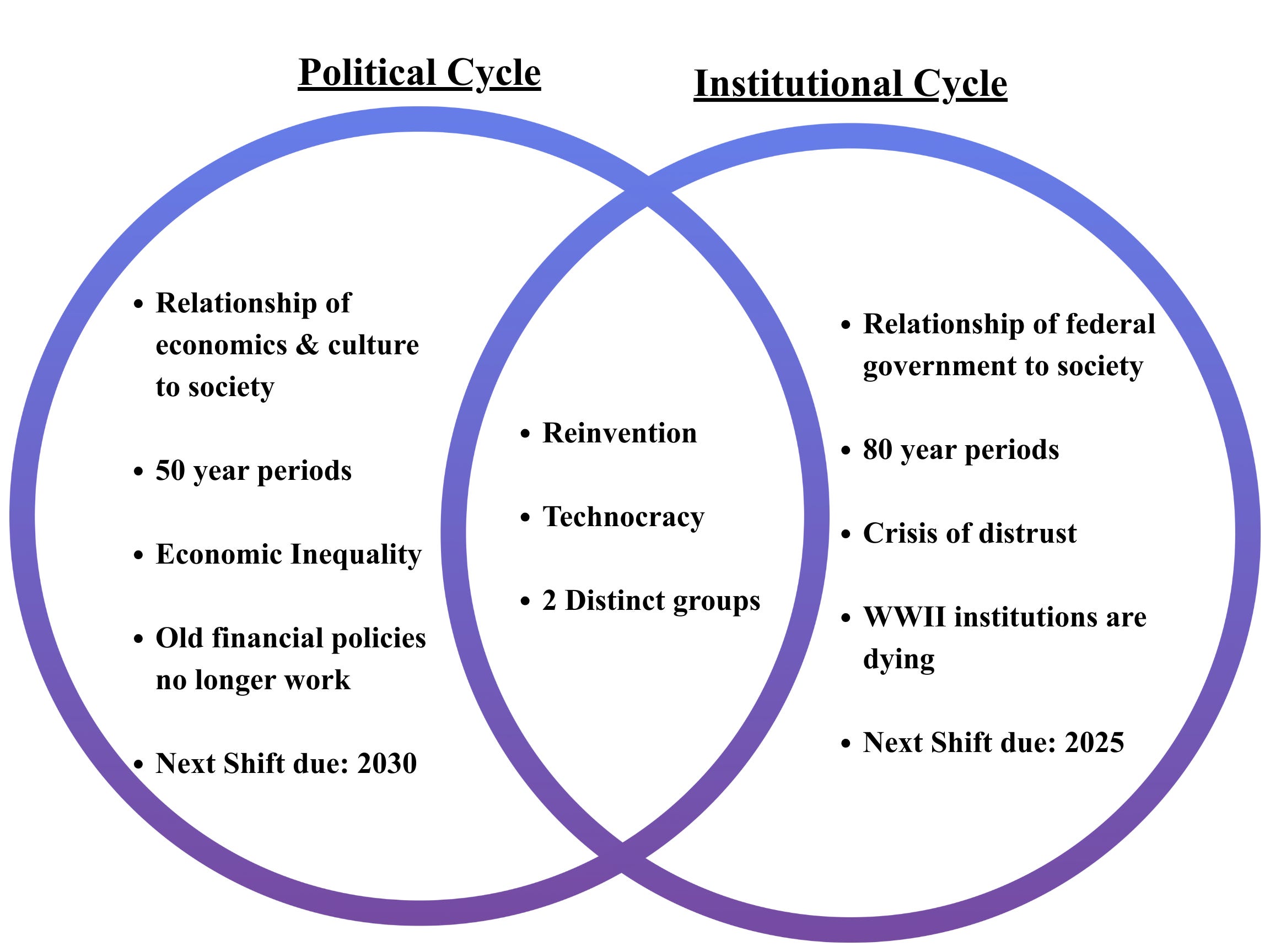
Governance requires results. The Federal Government has to change, because as of now, nobody is accountable for results: Congress blames the agencies, the agencies blame each other, and the problem continues. Right now our administrative state is no longer addressing the pain points (poor service, economic inequality), and nothing has fundamentally changed to address it. But it will. At some point, political pressure will force the system to change. A political storm is brewing, connected to two independent cycles that are crashing at once (the political and the institutional cycles). Economic inequality must be addressed and how our Federal Government functions must be altered. Both are coming due around now.
Implications
The major implications are largely political and bureaucratic. Because the Fed is so entangled in our lives, either directly or indirectly through regulations, all facets of American life will be touched as the Federal Government is reborn. The changes could be widespread and fast—anything and everything. The signs are pointing to the Congress and new President after 2028 to bring the change, but it could be as late as 2032.
The area that could have the greatest pain is actually psychological—any educated person or expert. In typical American fashion we could swing to an equal but opposite extreme and devalue expertise and education itself. We are already seeing this in Trumps admin, particularly in the CDC under Robert Kennedy. For over eighty years, expertise and education have been held up as the ultimate trait, but we may enter a period where it is treated with disdain. But don’t fall for the same error—specialization is vital, but it can’t operate in a silo. We need more foxes in the system, generalists, surrounded by hedgehogs. A fox without a hedgehog can be just as bad as a siloed hedgehog.
The Next Eighty Years…
We’ve all heard “this is the most important election of your life”, but what if instead you heard “the 2028 presidential election could determine the next fifty to eighty years?” Rings a little different, doesn’t it? The next decade could determine the next fifty years (political cycle) and create new institutions for the next eighty years (institutional cycle).
We were born and lived in a world that was ruled by the very institutions our great-grandparents built. Only a handful of generations get the opportunity to have that kind same impact—we’re one of them.
They fought WWII and left institutions that served us until just a few years ago. Carry that same gratitude with you as you evaluate who should serve as our next president. You can contribute to the next eighty years of history…slow down, pay attention, and make wise choices.
Let your grand children in 2110 be proud of your actions in the 2030s, just as we are grateful to our great grandparents.
As Hamilton tells us, “History has it eyes on you.”
George Friedman, The Storm Before the Calm
Ditto!